
Quantum Computing: The Future of Computational Power
Quantum computing represents one of the most revolutionary paradigms in modern science and technology. While classical computing has driven the digital revolution for over half a century, it operates under the constraints of binary logic—bits that can exist only as 0 or 1. Quantum computing, however, leverages the strange and powerful principles of quantum mechanics, allowing data to exist in multiple states simultaneously. This enables certain classes of problems to be solved exponentially faster than with classical computers. Although still in its developmental stages, quantum computing promises to redefine cryptography, optimization, drug discovery, materials science, and artificial intelligence.
This feature explores the conceptual foundations, historical evolution, core mechanisms, technological implementations, challenges, and future prospects of quantum computing, providing a holistic understanding of this transformative field.
The Classical Computing Paradigm
To appreciate quantum computing, it’s essential to understand the limitations of classical computing. Traditional computers process information in bits, each representing a definite state of 0 or 1. Logical operations manipulate these bits through transistors, which act as electronic switches. Despite astonishing advances in miniaturization described by Moore’s Law, physical and thermodynamic limits are being approached. As transistor sizes approach the scale of individual atoms, quantum effects—once negligible—begin to interfere with reliable computation.
This impending barrier motivates a new computational paradigm that doesn’t fight quantum effects but instead harnesses them: quantum computing.
Foundations of Quantum Mechanics
Quantum computing draws directly from the principles of quantum mechanics, the branch of physics governing the behavior of matter and energy at atomic and subatomic scales. Three key quantum principles underpin quantum computation:
Superposition
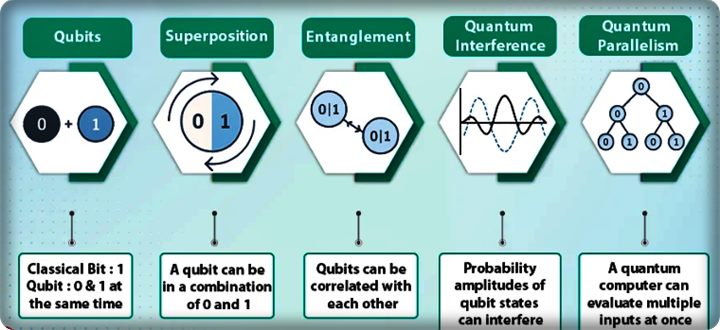
Unlike a classical bit that is either 0 or 1, a quantum bit or qubit can exist in a linear combination of both states simultaneously. This property, known as superposition, enables a quantum computer to process many possibilities in parallel. Mathematically, a qubit’s state is expressed as: ∣ψ⟩=α∣0⟩+β∣1⟩|\psi\rangle = \alpha|0\rangle + \beta|1\rangle∣ψ⟩=α∣0⟩+β∣1⟩
where α\alphaα and β\betaβ are complex probability amplitudes, and ∣α∣2+∣β∣2=1|\alpha|^2 + |\beta|^2 = 1∣α∣2+∣β∣2=1.
Entanglement
Entanglement is a uniquely quantum phenomenon in which the states of two or more qubits become correlated such that the state of one instantaneously affects the state of another, regardless of distance. This enables qubits to work together in ways impossible for classical bits, allowing for complex, correlated computations.
Interference
Quantum systems can interfere constructively or destructively depending on their probability amplitudes. Quantum algorithms exploit interference to amplify the probability of correct answers while suppressing incorrect ones, leading to computational speedups.
The Qubit: The Building Block of Quantum Computers
Qubits can be physically realized using various quantum systems, including:
- Superconducting circuits: Tiny loops of superconducting material interrupted by Josephson junctions. These are the basis of IBM and Google’s quantum processors.
- Trapped ions: Ions confined and manipulated by electromagnetic fields. IonQ and Honeywell use this approach for high-fidelity qubits.
- Photonic qubits: Encode information in the polarization or path of photons. This approach benefits from long coherence times and room-temperature operation.
- Spin qubits: Utilize the spin state of electrons in semiconductor quantum dots, pursued by companies like Intel and researchers at Delft University.
- Topological qubits: Still largely theoretical, these qubits are expected to be more robust to noise and decoherence by exploiting exotic quasiparticles called anyons.
Each qubit type has trade-offs in terms of coherence time, gate fidelity, scalability, and ease of fabrication.
Quantum Gates and Circuits
Quantum gates are the quantum analogs of classical logic gates. They manipulate qubits through precise operations represented by unitary matrices that preserve quantum information. Common quantum gates include:
- Pauli-X gate (analogous to NOT)
- Hadamard gate (creates superposition)
- CNOT gate (entangles two qubits)
- Phase and T gates (control phase shifts)
Quantum algorithms are implemented as sequences of such gates forming quantum circuits. Unlike classical circuits, quantum circuits must maintain coherence—quantum information cannot be copied or observed directly without collapsing the wavefunction (a consequence of the no-cloning theorem).
Quantum Algorithms
The potential of quantum computing lies in its algorithms, many of which provide exponential or polynomial speedups compared to classical methods.
Shor’s Algorithm (1994)
Developed by Peter Shor, this algorithm can factor large integers exponentially faster than the best-known classical algorithms. It poses a direct threat to RSA and other public-key cryptosystems that rely on the difficulty of prime factorization.
Grover’s Algorithm (1996)
Proposed by Lov Grover, this algorithm provides a quadratic speedup for unstructured search problems. While less dramatic than Shor’s exponential speedup, it demonstrates broad applicability across optimization and data search tasks.
Quantum Simulation
Richard Feynman first proposed in the 1980s that quantum systems could be simulated efficiently only by other quantum systems. Quantum computers excel at simulating molecular interactions and quantum materials, revolutionizing chemistry, drug design, and nanotechnology.
Quantum Machine Learning
Quantum computers can, in theory, accelerate certain subroutines in machine learning such as linear algebra, sampling, and optimization. Hybrid algorithms like Quantum Approximate Optimization Algorithm (QAOA) and Variational Quantum Eigensolver (VQE) bridge classical and quantum processing to tackle near-term problems.
The Hardware Landscape
The race to build practical quantum computers is led by major technology firms and startups, each pursuing different hardware architectures:
- IBM Quantum: Offers cloud-based superconducting qubit systems and a well-developed software ecosystem (Qiskit).
- Google Quantum AI: Demonstrated “quantum supremacy” in 2019 using its 53-qubit Sycamore processor.
- IonQ and Honeywell: Lead the trapped-ion approach with high coherence times and gate fidelities exceeding 99%.
- Rigetti Computing: Develops modular superconducting systems emphasizing hybrid quantum-classical integration.
- D-Wave Systems: Focuses on quantum annealing, a specialized form of quantum computation optimized for combinatorial optimization.
Each platform faces distinct engineering challenges: increasing qubit count, reducing noise, improving error rates, and integrating control electronics.
Quantum Error Correction and Decoherence
One of the greatest challenges in quantum computing is decoherence—the tendency of qubits to lose their quantum state due to interactions with the environment. Quantum states are extremely fragile; even thermal vibrations or electromagnetic noise can destroy the information.
To mitigate this, researchers employ quantum error correction (QEC). Unlike classical error correction, QEC must avoid direct measurement. Logical qubits are encoded into multiple physical qubits to detect and correct errors without collapsing the quantum state. The most promising scheme is the surface code, which requires thousands of physical qubits per logical qubit. Reaching this level of error-corrected scalability is often referred to as achieving fault-tolerant quantum computing.
Quantum Supremacy and Advantage
The term quantum supremacy refers to the moment when a quantum computer performs a calculation infeasible for any classical supercomputer. Google’s 2019 experiment claimed such a milestone, completing a random circuit sampling task in 200 seconds—a task estimated to take classical supercomputers 10,000 years. While some debate remains about the precise interpretation, the demonstration proved that quantum devices can outperform classical machines for specific, contrived tasks.
The next goal is achieving quantum advantage—delivering practical performance gains in real-world applications like logistics optimization, materials design, and financial modeling.
Applications of Quantum Computing
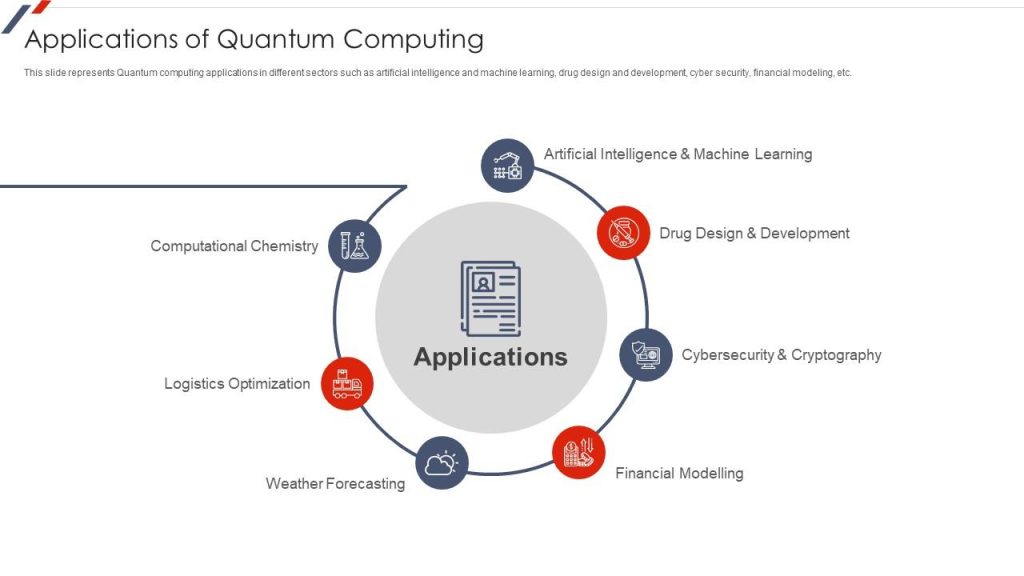
Cryptography
Quantum computers threaten classical encryption but also inspire new forms of quantum cryptography, such as Quantum Key Distribution (QKD), which provides provably secure communication using quantum states.
Drug Discovery and Chemistry
Quantum simulation allows accurate modeling of molecular interactions that are intractable for classical computers. Companies like Roche, Pfizer, and BASF are exploring quantum chemistry for faster, cheaper drug development.
Optimization Problems
Quantum algorithms can improve complex optimization tasks found in logistics, finance, and machine learning. For example, quantum annealers tackle problems like route optimization or portfolio balancing.
Artificial Intelligence
Quantum machine learning could enhance pattern recognition, clustering, and reinforcement learning. Hybrid quantum-classical models are being developed to accelerate neural network training.
Materials Science
Quantum simulations can predict the properties of new materials, such as superconductors, catalysts, or battery components, enabling breakthroughs in sustainable energy and electronics.
The Quantum Software Ecosystem
Software frameworks and programming languages are evolving rapidly to support quantum algorithm development. Notable examples include:
- Qiskit (IBM) – Python-based SDK for designing, simulating, and running quantum circuits.
- Cirq (Google) – Optimized for near-term quantum processors.
- Q# (Microsoft) – Integrated into the Quantum Development Kit.
- Braket (Amazon) – Cloud platform providing access to multiple quantum hardware types.
- PennyLane and TensorFlow Quantum – Enable hybrid quantum-classical machine learning.
These tools democratize access to quantum computing resources, allowing researchers and developers to experiment without direct hardware ownership.
Challenges and Limitations
Despite rapid progress, quantum computing faces formidable obstacles:
- Scalability: Building systems with millions of qubits is necessary for fault-tolerant computing but remains technologically distant.
- Error Rates: Even the best qubits today experience significant gate and readout errors.
- Cryogenic Requirements: Most quantum processors require near-absolute-zero temperatures.
- Cost and Complexity: Quantum systems demand precise fabrication, isolation, and control infrastructure.
- Algorithmic Development: Only a handful of algorithms show clear quantum advantage; finding more practical applications remains an open challenge.
Ethical and Security Implications
Quantum computing’s ability to break classical encryption raises global security concerns. Governments are preparing for a “post-quantum” world by developing post-quantum cryptography (PQC)—algorithms secure against quantum attacks. Ethical considerations also extend to equitable access, data privacy, and environmental impact of large-scale quantum infrastructure.
The Future of Quantum Computing
Experts predict that within the next two decades, quantum computing will transition from laboratory prototypes to commercially valuable tools. The roadmap includes several stages:
- Noisy Intermediate-Scale Quantum (NISQ) era (present–2030): Characterized by 50–1000 qubit machines capable of specialized tasks but not full fault tolerance.
- Fault-Tolerant Quantum Computing (2030–2040): Large-scale, error-corrected systems enabling exponential speedups for chemistry, AI, and cryptography.
- Quantum-Classical Integration: Hybrid systems where classical processors handle control and optimization while quantum co-processors perform high-dimensional calculations.
The future likely involves a collaborative ecosystem—cloud-based quantum services integrated into traditional computing workflows, accessible to researchers and industries alike.
Quantum computing stands at the frontier of science, merging physics, mathematics, computer science, and engineering into a singular endeavor to transcend classical limits. Though practical quantum computers remain a work in progress, their potential impact rivals that of the transistor or the internet. The ability to simulate nature’s fundamental processes, accelerate computation beyond classical boundaries, and revolutionize security and artificial intelligence underscores the transformative power of quantum mechanics in computation.
As researchers refine qubit technologies, error correction, and scalable architectures, the dream of harnessing quantum phenomena for real-world computation draws ever closer. Quantum computing is not just a technological revolution—it represents a profound shift in how humanity conceives information, logic, and reality itself.