
Augmented Reality: Bridging the Physical and Digital Worlds
In the past two decades, technological advancements have blurred the boundary between the physical and digital worlds. One of the most transformative innovations driving this convergence is Augmented Reality (AR). Unlike virtual reality (VR), which immerses users in a fully digital environment, AR overlays computer-generated images, sounds, and information onto the real world, enhancing rather than replacing reality.
From interactive gaming and navigation apps to healthcare simulations and industrial design, AR has rapidly evolved from a futuristic concept to a practical tool reshaping industries and daily life. As computing power, sensors, and connectivity improve, AR stands poised to revolutionize how humans perceive, interact with, and understand their surroundings.
What is Agentic AI
At its core, Agentic AI refers to artificial-intelligence systems that go beyond simply responding to prompts or performing narrowly defined tasks. Instead, they can act autonomously, set or recognise goals, plan multi-step workflows, adapt to changing conditions, and in some cases collaborate with other agents or humans.
Some key definitions:
According to IBM: “Agentic AI is an artificial intelligence system that can accomplish a specific goal with limited supervision… it consists of AI agents … coordinated through AI orchestration.”
In simpler terms: imagine an AI not just waiting for you to ask, but figuring out you need something, planning how to do it, coordinating sub-tasks, interacting with external systems, and executing it — with minimal human oversight.
Evolution and History of Augmented Reality
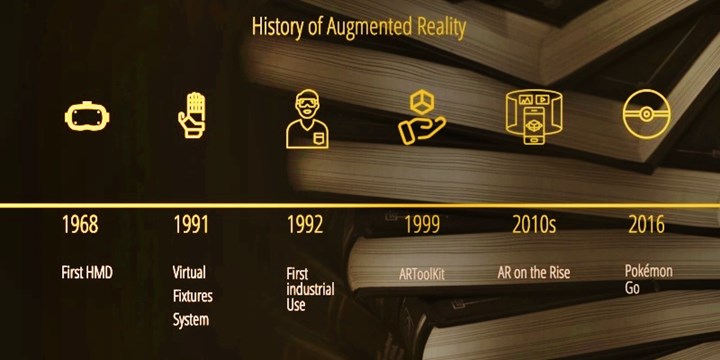
- 1968: Ivan Sutherland created the first head-mounted display system, often considered the earliest AR prototype.
- 1990s: Boeing engineers Tom Caudell and David Mizell used AR for airplane wiring.
- 1998: The NFL introduced the first televised “virtual 1st down line,” an early mass-market AR example.
- 2013: Google Glass brought AR to mainstream awareness.
- 2016: Pokémon GO became a global sensation, showing AR’s entertainment potential.
- 2020s: Advances in 5G, AI, and lightweight headsets are driving AR into new frontiers—from education to industrial maintenance.
How Agentic AI Works – Key Components
To build a system that genuinely qualifies as “agentic”, several architectural and functional features come into play:
Autonomy & Goal-Oriented Behaviour
These systems don’t just await a command; they set or interpret goals, break them down into steps, and work toward achieving them.
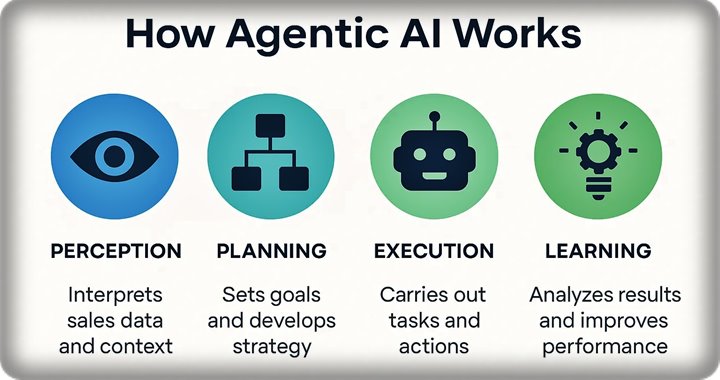
Perception, Planning, Acting
According to NVIDIA’s blog: An agentic system typically operates in phases:
- Perceive: gathers data (sensors, APIs, databases)
- Reason/Plan: uses models (often large-language models or orchestration modules) to decide what to do
- Act: executes actions — calls tools, interfaces with systems, etc.
And often learns or adapts as it proceeds.
Multi-Agent Orchestration
Many agentic systems are composed of multiple collaborating agents (or sub-agents), each specialised for a sub-task, coordinated by an orchestrator.
Environment Interaction & Adaptation
Unlike simple task bots, agentic systems monitor the environment (including real-world change), adapt their strategy, can backtrack or revise plans.
Memory / State / Persistence
For a system to act autonomously over time (not just one prompt → one response), it typically needs memory of past interactions, state-tracking, context. Cognigy notes “retentive memory” is a feature.
How Agentic AI Different from Traditional AI or AI Agents?
There’s sometimes confusion, so clarifying helps:
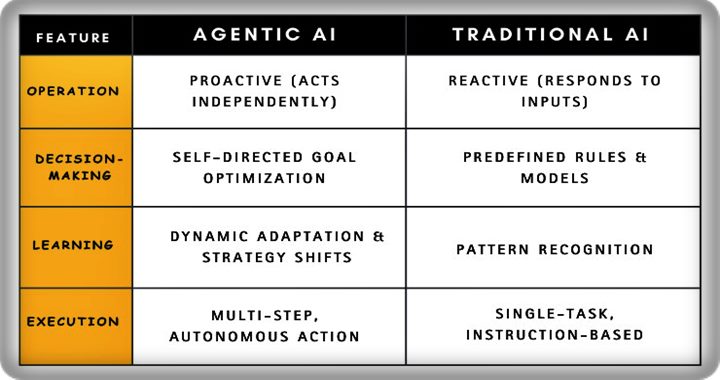
- Traditional AI / Generative AI: LLMs, models that are primarily reactive: you ask a question, you get an answer. They don’t necessarily plan multiple steps nor act in the world.
- AI Agents: These are autonomous software entities designed for specific tasks (e.g., a scheduling assistant agent). They may have some autonomy, but are often narrow in scope.
- Agentic AI: A system of agents + orchestration + memory + planning + action in the world; goal-oriented and multi-step.
Use-Cases & Potential Applications
Agentic AI is already being explored across many domains. A few examples:
- Enterprise workflows: Coordinating back-office tasks, e.g., a system that monitors invoices, cross-checks data, sends payments, resolves discrepancies.
- Customer service / support: Instead of simply answering a query, the system might identify a customer’s issue, pull relevant data, negotiate a solution, follow-up.
- Supply chain / logistics: Monitoring real-time data (weather, shipping delays), rerouting shipments automatically, coordinating with vendors. (mentioned in commentary)
- Scientific research / discovery: Agentic systems that plan experiments, merge data sources, iterate proposals.
- Autonomous systems / robotics: Vehicles, drones, physical systems that perceive their context, plan multi-step actions, adapt.
Benefits & Promises
- Scalability of complex tasks: Rather than requiring humans to direct every step, agentic systems can take over multi-step workflows.
- Efficiency & speed: They reduce manual coordination, delay, hand-offs.
- Adaptiveness: Can respond to changing conditions in real-time rather than rigid scripts.
- Personalisation: Because they can remember context and adapt, they can offer more tailored solutions.
Challenges, Risks & Limitations
With great autonomy come greater risks.
Maturity & ROI concerns
Reports suggest many projects still experimental; one article cited > 40% of agentic AI projects expected to be scrapped by 2027 for cost / unclear business value.
Data quality & “garbage in, agentic out”
Autonomous systems rely on high-quality data; poor data can lead to bad decisions.
Accountability / Liability
When an agentic system acts and makes decisions, who is responsible? Legal, ethical, authorship issues become complex.
Safety & Trust
Especially when autonomous, there’s risk of catastrophic failure if assumptions are wrong, or environment changes. Trust-worthy design, transparency become vital.
Governance & Ethics
Ensuring such systems align with human values, operate fairly, and aren’t biased or manipulated.
Mis-labeling / “Agent washing”
Some vendors or projects might claim “agentic AI” but deliver essentially narrow, scripted bots. Gartner warns about this.
Building Blocks
To implement agentic AI successfully, certain enablers are key:
- Strong foundational models (LLMs etc) that can reason, plan, and generate.
- Orchestration layer: managing agents, workflows, memory, tool use.
- Tooling / API access: agents must integrate with external systems (databases, web APIs, sensor networks).
- Memory / state management: to persist context over sessions.
- Feedback & learning loops: the system must adapt, improve over time.
- Governance, audit trails & transparency: especially when autonomous decisions are made.
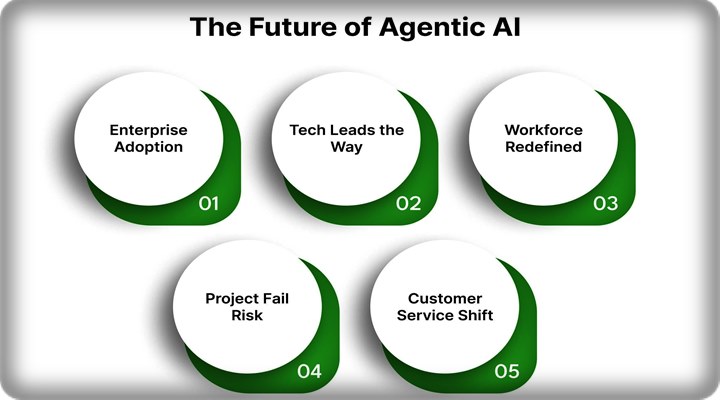
Future Outlook
- Agentic AI is likely to become more common in enterprise software, workflow automation, and even consumer tools.
- Over time, as maturity grows, the fraction of business decisions made autonomously will increase. (E.g., predictions that by 2028 a substantial portion of enterprise software will include agentic AI.) Reuters
- Hybrid architectures (neural + symbolic) may become standard to combine adaptability with reliability. arXiv
- Governance frameworks and regulatory standards will be increasingly important.
- New business models will emerge around “autonomous agents as a service”.
Considerations for Implementation
If you or an organisation are thinking about deploying agentic AI, some key questions:
- What goal is this system trying to achieve? Is it clearly defined but complex/multi-step?
- Is the organisational data / tool ecosystem ready? Are APIs available? Data accessible and clean?
- What level of human oversight & control is needed? Especially early on, human-in-the-loop may be wise.
- How will you measure success / ROI? Since many projects still struggle to deliver value, clarity on metrics is important.
- What are the risks? Data privacy, security, unintended actions, accountability must be addressed.
- Is the vendor / tech partner clear about what “agentic” means in their system? Avoid over-hyped claims.
Agentic AI represents a significant evolution in how we think about AI systems — from tools that answer, to agents that act. When done well, it offers powerful potential: automation of complex workflows, adaptive decision-making, and integration across systems. But the path is not without hurdles: maturity, data, governance and clarity of purpose are all critical.
For organisations and individuals alike, the key is to approach agentic AI not as a silver bullet, but as a highly capable new modality — one that demands thoughtful architecture, clear goals, and robust safeguards.
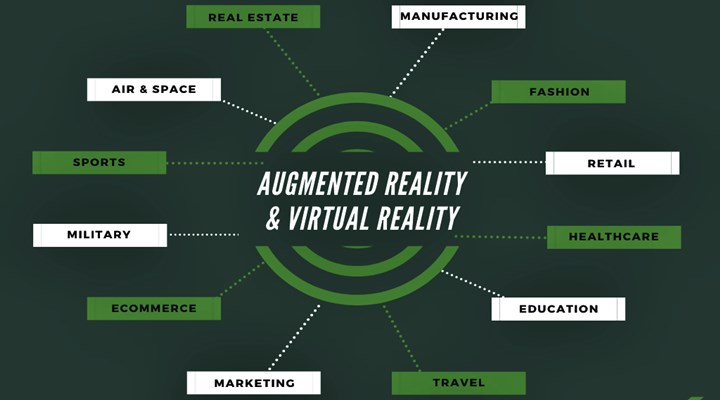
Applications of Augmented Reality
AR has moved beyond entertainment to impact nearly every industry.
Education and Training
AR enhances learning by making abstract concepts tangible. Students can visualize molecules in 3D, explore virtual historical sites, or simulate physics experiments.
- Example: Apps like Google Expeditions and Merge Cube allow students to interact with digital objects in real environments.
- Medical training: Students use AR to visualize anatomy or practice surgeries virtually before operating on real patients.
Healthcare
AR assists doctors and medical professionals in diagnosis, surgery, and patient education.
- Surgical guidance: Systems like AccuVein project veins on patients’ skin to help locate blood vessels.
- Rehabilitation: AR games motivate patients in physical therapy.
- Medical imaging: AR overlays CT scans or MRI data onto a patient’s body during procedures for precision.
Manufacturing and Maintenance
AR provides workers with step-by-step visual instructions, reducing errors and increasing productivity.
- Example: Boeing uses AR to assist in aircraft wiring, improving accuracy and efficiency.
- Maintenance: Engineers can view machine diagnostics and repair instructions hands-free using AR glasses.
Retail and E-Commerce
AR enables customers to “try before they buy.”
- Examples:
- IKEA Place lets users visualize furniture in their home.
- L’Oréal’s AR app allows virtual makeup trials.
- Car companies like BMW offer AR-based virtual showrooms.
Tourism and Navigation
AR enhances travel experiences by providing interactive information about landmarks, museums, or restaurants.
- Example: Google Maps Live View overlays navigation arrows directly onto the street view, improving direction accuracy.
Entertainment and Gaming
AR’s most famous application lies in gaming.
- Pokémon GO and Ingress combine GPS, cameras, and AR to blend virtual adventures with real-world exploration.
- In movies and sports, AR enhances live broadcasts with virtual scoreboards and visual effects.
Military and Defense
AR assists soldiers with situational awareness, navigation, and training.
- Example: The U.S. Army’s IVAS (Integrated Visual Augmentation System) overlays tactical data, maps, and target identification into a soldier’s field of view.
Architecture and Real Estate
AR allows architects and buyers to visualize buildings or renovations before construction.
- Clients can “walk through” virtual models overlaid on physical spaces.
- ARki and MagicPlan are popular AR design tools.
Advantages of Augmented Reality
- Enhanced Learning and Retention: AR’s interactive nature helps users understand and remember complex information.
- Improved Productivity: Real-time visual instructions reduce human error in manufacturing and maintenance.
- Cost Efficiency: AR simulations cut costs in training, prototyping, and travel.
- Better Customer Experience: Personalization and visualization lead to higher engagement and satisfaction.
- Accessibility: AR can make information more intuitive and accessible to people with disabilities through visual or auditory augmentation.
Challenges and Limitations
Despite its potential, AR faces several challenges.
Technical Limitations
AR requires significant processing power and precise tracking to ensure smooth and accurate overlays. Battery life, display brightness, and latency remain issues for wearable devices.
Cost and Accessibility
High-quality AR headsets and software development are expensive, limiting adoption in smaller organizations or developing regions.
Privacy and Security
AR applications often require access to cameras, location data, and surroundings, raising privacy concerns. Unauthorized recording or data breaches can violate user rights.
Ethical and Psychological Concerns
Over-reliance on augmented environments may distort perception of reality. Moreover, misinformation through AR (for example, falsified visual overlays) could have harmful consequences.
User Acceptance
Many consumers are still hesitant to adopt AR wearables due to comfort, aesthetics, and social stigma—Google Glass faced backlash partly for this reason.
Technologies Enabling Augmented Reality
AR’s rapid growth is supported by several key technologies:
- Computer Vision: Enables devices to interpret and understand real-world visuals.
- Artificial Intelligence (AI): Helps AR systems recognize objects, process speech, and adapt experiences.
- 5G Connectivity: Reduces latency and enables real-time AR streaming.
- Cloud Computing: Stores and processes massive AR data, supporting large-scale, collaborative environments.
- Sensors and IoT: Collect environmental data to enhance interactivity.
- Wearable Devices: AR glasses (e.g., Microsoft HoloLens, Magic Leap) and smart contact lenses are making immersive AR experiences more natural.
Augmented Reality vs. Virtual Reality vs. Mixed Reality
| Feature | Augmented Reality (AR) | Virtual Reality (VR) | Mixed Reality (MR) |
|---|---|---|---|
| Environment | Combines real and virtual elements | Fully immersive digital world | Seamless integration of real and virtual with real-time interaction |
| Device | Smartphones, tablets, AR glasses | VR headsets | HoloLens, advanced MR headsets |
| Interaction | Enhances real-world perception | Replaces real world | Merges both worlds interactively |
| Example | Pokémon GO | Oculus Rift experiences | Microsoft HoloLens |
The Future of Augmented Reality
The future of AR looks promising as hardware becomes smaller, cheaper, and more powerful.
Integration with AI and IoT
AI-driven AR will personalize experiences, while IoT integration will allow AR systems to interact with smart environments—like showing energy usage directly over appliances.
AR Cloud and Persistent AR
Developers are building an “AR Cloud,” a shared digital layer of the real world that enables persistent, location-anchored AR experiences. This could turn the world into an interactive digital canvas.
Widespread Adoption in Business
By 2030, most industries are expected to use AR for design, collaboration, and maintenance. According to PwC, AR and VR could add $1.5 trillion to the global economy by 2030.
Social and Cultural Impact
AR will transform social interactions, education, and entertainment, blurring the line between online and offline experiences. However, ethical frameworks will be essential to manage privacy and misinformation.
Case Studies
Pokémon GO (2016)
The mobile game became a cultural phenomenon, demonstrating AR’s ability to engage millions through location-based gameplay. It generated over $6 billion in revenue by 2024.
Microsoft HoloLens in Industry
Used in manufacturing and healthcare, HoloLens provides real-time visualization and remote collaboration, reducing operational errors by up to 25%.
IKEA Place
By letting users visualize furniture in their homes before purchase, IKEA revolutionized online shopping with AR, boosting customer confidence and reducing returns.
Ethical Considerations
As AR becomes ubiquitous, ethical concerns emerge:
- Privacy: Constant data capture could enable surveillance.
- Consent: Users in shared environments must be aware when they are being recorded or tracked.
- Digital Divide: Unequal access could widen technological inequality.
- Reality Manipulation: AR content could distort perception, influencing opinions or spreading misinformation.
Governments and technology firms must collaborate to establish ethical guidelines, privacy regulations, and safety standards for AR use.
Augmented Reality stands at the intersection of imagination and innovation. By seamlessly blending digital elements with the physical world, AR enhances how we learn, work, shop, play, and interact. Its applications span nearly every domain—from classrooms and hospitals to factories and living rooms—making information more immersive and accessible.
However, with great potential comes great responsibility. Addressing privacy, ethical, and technical challenges is crucial to ensuring AR’s responsible growth. As technology advances toward lightweight wearables, 5G connectivity, and AI integration, AR will evolve from novelty to necessity—reshaping human experience in the decades ahead.
In essence, Augmented Reality is not just about overlaying images on the world—it’s about augmenting human capability and perception, bridging the physical and digital realms to create a more connected, informed, and interactive future.